
Forming Chords From Scales


 by
by 
Chords typically occur together in families. There are certain groups of chords that when used together, often sound good.
The most common way of forming families of chords that sound good together is to form a set of chords from a scale. When you do this, you will have a number of chords that all belong to the same key. In this article, I’ll show you through how to form a family of chords from a scale.
By understanding this, you will understand why certain chords work well together in a given key and be able to start to see these families of related chords being used in the music you learn.
Lets start by forming triads (three note chords) from a major scale. To make things easy lets use C Major as our scale here.
The notes of the C Major scale are as follows:
C D E F G A B C
Each of the notes of this scale can be used to build a chord on. In order to do this, start at a given note, say C. then add to that note the note that is a third (or two notes) up on the scale. In our example, this is E. Then add the note that is a 5th up on the scale (or moving up another 2 notes from our third). Here we have G.
You can see this illustrated here:
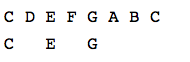
With these three notes, (C, E and G) we have the C major chord and this is the chord formed from the first note of the C major scale.
We then want to repeat this process by forming chords from each of the other notes of the scale. So we then move to forming a chord off the note D. By moving a third up from D in the C major scale we have the note F and then moving a 5th up we have the note A.
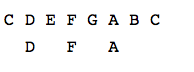
The notes D, F and A form the D minor chord.
By moving up each note of the scale and forming a chord on the note by adding the 3rd and the 5th from that note in the scale, we form a family of 7 related chords as follows:
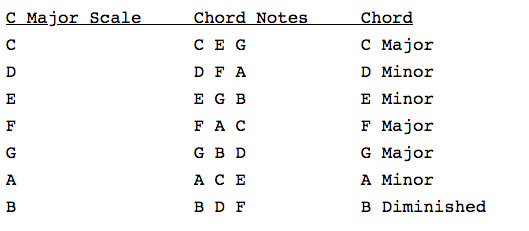
When you form the notes of the chord like this, you know if the chord is a major, minor or diminished chord by the distance between the notes in the chord.
A major chord has a major third and a perfect fifth as the intervals from the root note (or the note the chord is based on).
On a guitar a major third is the distance between two notes that are 4 frets apart while a perfect fifth are two notes that are 7 frets apart.
A minor chord is formed from a minor third (notes that are 3 frets apart) and a perfect fifth.
A diminished chord is formed from a minor third and a diminished 5th (6 frets apart).
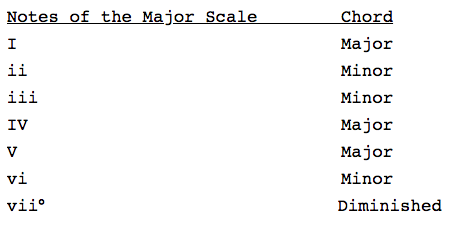
It is useful to number the notes of the scale. So for C Major, we have the numbering of notes (in Roman Numerals):

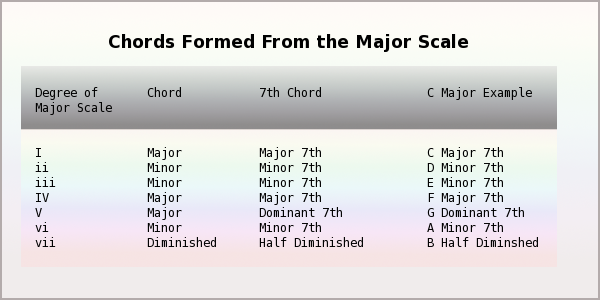
When we number the notes of any major scale like this, we always have the same combination of major, minor and diminished chords formed from the scales as follows
Forming 7th Chords from the Major Scale
We have seen above how to form families of major, minor and diminished chords from the major scale. We can apply the same concept to form 7th chords. When you use families of 7th chords, the sound of the chord progression will typically sound more harmonically rich, or interesting.
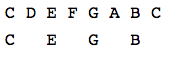
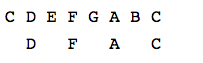
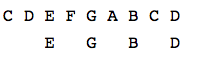
You form a family of 7th chords in the same way we formed the triads above, however, as well as adding a third and a fifth to each note of the scale, you should also add a 7th as well. The 7th will be the note that is two notes up from the 5th in the scale.
So to look at a few examples in C Major. Forming the 7th chord from the note C you have:
Forming the 7th chord from the note D, you get
Forming the 7th chord from the note E, you get
and so on.
When we form 7th chords on each note of the c major scale, you get
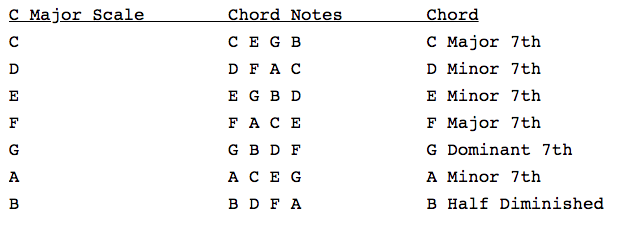
And when we base this on the numbering of the scale, for any major scale we will have:
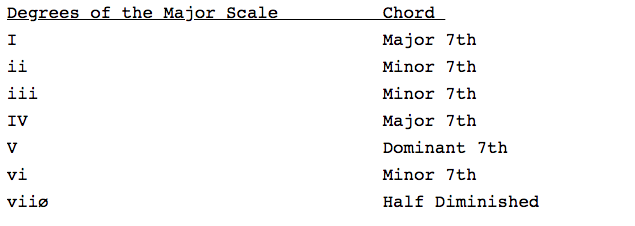
In forming these chords the interval of the 7th also plays a role in determining the chord type. The chord formed is a Major 7th chord if the triad formed is major and the 7th is then a Major 7th interval from the root of the chord (this would be 11 frets higher than the root note if on a single string).
A Dominant 7th chord has a major triad and the 7th is a Minor 7th from the root note (a distance of 10 frets).
A Minor 7th has a minor triad and the 7th is a minor 7th from the root note while a half diminished chord has a diminished triad and a minor 7th.
We have seen here how to form chords from the major scale. The same concept can be applied to any diatonic scale (7 note scale) such as the harmonic minor scale, the natural minor scale or the various modes of the scales.
The method to do this is the same, you simply have a different set of notes in the scale that you are forming chords from and using to form your thirds, fifths and seventh notes for each scale tone.
When we devote an article to a given scale we will often outline the set of chords that are formed from applying this method to the scale being discussed.
As well as the major scale shown here, you can see the results of applying this method in such articles as our page on the natural minor scale.
Exercise to Help Your Understanding
If you would like to improve your understanding of this concept, I recommend to take a look at the chord progressions in the transcriptions of some of our major scale backing tracks and natural minor scale backing tracks. As you do this, work through the progressions and see that the chords from these progressions are from the relevant major for natural minor scale for the backing track.
Some of the chords here won’t simply be triads or 7th chords but may contain 9th, 6th, etc, but the notes of the chords still do come from the scale. When you see a chord progression like these formed from a given scale, that is a strong indicator that you can use that scale to improvise and form solos over the chord progression. Listen to the tracks, and this will illustrate how the chords formed from a scale can work together in a family to create a coherent chord progression.
by 
hi there..alex here..Im 49 years young (lol) and just pick up the guitar 6months ago and starting to play but I can tell you that I have been looking for this info for all this time to have an understanding about how the chords made up especailly sus and 7th cords now the confuse and learning chords quicker is come to light..thank you and I will love to see more of your tutorial in the future..thanx again
Hi Alex,
I’m glad you found the post useful.
Also for sus chords you form them in a similar way but there is no third and it is typically replaced by a perfect 4th. For example, on the major scale instead of forming the major chord from degrees 1, 3 and 5 if you formed the chord from degrees 1, 4 and 5 you would have a sus chord.
Thanks for stopping by the site.
Can you explain what makes the 5th position a dominant chord and the 7th position half diminished on the 7th chords. It seems like the 5th position should just be a major chord.
Hi Jeffrey,
The fifth chord is dominant rather than just major because the 7th is a minor 7th. If the 7th was an interval of a major 7th then the chord would be major 7.
A half diminished chord is made up of the intervals: root, minor 3rd, diminished 5th and minor 7th.
When your looking at these 7th chords, the interval of the 7th also plays a role in determining the chord type.
Hello,
Thx for this info. Its helping me a lot but I cant apply it for example when I play the A penatonic minor scale.
When Trying to find the right chords Im struggling.
Would be great if you had some examples in other keys aswell.
tnx for this, but still cant undestand the 7th chord. The 7th usually is behind the tonic.
Does that mean adding the 7th requires lifting my finger from the tonic? Combining them is a whole lot of challenge to me.
Further why do we the 7th chord, and what kind of song or music does it fit in? When?
Maybe you need to send me a chord chart for the 7th chord.
Pleeeeeease…..
Thanks. I know you will.
Hi Chris,
Thats right that dropping the tonic down a degree would arrive at the 7th, but it is very rare to form a guitar chord shape in that way for a 7th chord.
In most chord shapes the tonic will still be the bass note and this is called root position. The 3rd, 5th and 7th will typically be added on the higher strings.
I would not really use this theory to initially figure out the shape of chords on the fretboard. I would suggest looking at existing chord shapes off the web or books for this.
You should eventually understand however which note in your chord shapes corresponds to which degree: the root, 3rd, 5th or 7th.
Unfortunately, I don’t have a chord chart I can send you for this.
Probably the primary use of this theory in the initial stages is not to figure out chord shapes on the neck, but rather understand which chords work together in a family of chords that form the same key. These families of chords often work together to form chord progressions in many styles of music.
Additionally, understanding this theory will often help you figure out which scale you should use to solo with. If you can figure out which scale all the chords in a progression are formed from, you can typically use this scale to form a solo over the progression.
7th chords have a more harmonically rich sound than basic triads, and as such are often used in fusion and jazz styles, but you will find them in virtually all styles of music.
Hope this helps.
Great explanation! i form the 7 chords by adding the flatted 7th on the B string .. or just by lifting the baby finger off of the root on the D string.. most everyone does this .. as you know it’s used a lot in blues progressions.
ps i really enjoyed the article .. got me thinking !
SP
Thanks a lot for this article, it helped me out greatly!!
Hey i am confuesed about the forming of chords like for c major you say its C E G but wheni ply a c i dont place my fingers on those notes. Same with the e minor. A e minor has only two string positions why do we have 3 notes?
Hey Dekota,
In these chords, each of these notes can be played at any octave and may be doubled up.
For example in the open position C the notes from the 5th string to the 1st are C E G C E.
In the case of Em, the notes for the open position chord from the 6th string to the first are E B E G B E.
So you can see here that some notes are doubled up and may be in different octaves.
Also, will just add that some of these notes ca be played on open strings.
Thank you so much this is helping me alot.
hey ,, i dont think that you can make D chord out of C major scale
The chord on D is a D minor rather than a D major chord. This is formed from the notes D, F and A which are all notes of the C major scale.
amaziiiiinnnggg stufffff .. thanksss for sharing this wid us … it helped me a lot … again thanks alot .
This is very helpful, but I do not understand it completely. Specifically, I’m a beginner and the open C Major Chord I learned has me fretting the following notes (C – 1st fret, E – 2nd fret, C – 3rd fret). Could you shed some light on this? Thanks!
Hi Bill,
With the open C chord, there’s also a G and an E on the open string, so it has the notes C E G C E. This is the same notes as above with some notes repeated in different octives. I wouldn’t use this theory to find chord fingerings but rather to understand how chords relate to each other as you learn the standard fingerings for chords.
Hi, Thank you so much for this article. You made it simple for a beginner like me. . . Can’t thank you enough.
When we number the notes of any major scale like this, we always have the same combination of major, minor and diminished chords formed from the scales as follows? If you were to start with the D note in position one, then would it not be minor minor major major… since D F A is minor chord?
Hi Don,
All major scales will have have the same combination. If you start from D then the major scale would be D major rather than C major: D E F# G A B C# D
Chord 1 is then D F# A which is D Major.
If you start and end a major scale on its second note, that would be a dorian mode. So the notes of C major, starting and ending on the D would be D dorian.
Hope this helps.
hey, just wanted to thank you man. the simplicity with which you explained these stuff is amazing. i have been trying to learn from youtube for a few months now and it always seemed too technical and complicated. but now its all falling into place after this article. thanks a lot.
Excellent article…this article clears which chords you need to play in a particular song if you know the scale of the song..beautifully described..thanks admin… 🙂
Can this be done in reverse? If I have a chord progression, can I determine the scale that it’s based on?
I know that an “A” chord is made up of the notes “A” “C#” and E. What makes the chord an “A” and not a “C#” or an “E” chord? Has it to do with the frequencies’.
Still waiting!!!
I’ll try to explain… 🙂
The A-Major chord is defined by the root note (A), plus the third and fifth notes of the A-Major scale – making the notes that form an A-Major Chord to be A, C# and E (like you point-out.)
But a C#-Major chord contains the first, third, and fifth notes of the C#-scale (not the A-scale), so the notes that build a C#-Major chord are: C#, F, and G#.
Likewise, a E-major chord is formed using the first, third, and fifth notes of the E-major scale: E, G, B. (A and C# “play” no part in building a E-Major chord.) Make sense?
Hi Mark,
Thanks very much for your input to the site. Very clear explanations!
Much appreciated,
Brett
Thanks. Just thanks…
I need worship chord
Why do we use note EGB instead of EBE for Em chord?
Doubt!!
Couldn’t cope out on B diminished and other major minor idea
Using the C Major scale above, we get the E G B to form a chord for E. If we transposed E G B to the chromatic scale of E, we will have a triad with a root (E), minor 3rd (G) and fifth (B ) which is the Em chord. Same goes for all the notes in the C scale, you can simply transposed them to their own chromatic scale. Thus we get the Major, Minor, Minor, Major, Major, Minor, Diminished triad from a major scale.
I believe major, minor and diminished are already explained. Let me jus quote it:
“A major chord has a major third and a perfect fifth as the intervals from the root note (or the note the chord is based on).
A minor chord is formed from a minor third (notes that are 3 frets apart) and a perfect fifth.
A diminished chord is formed from a minor third and a diminished 5th (6 frets apart).”
Hopes this helps. God bless =>
how can I play on # (sharps) I want I learn the chord progression of Sharps and flat. like c# the progression f the chord, how to find it and them.
how do I form the sofa chord of sharp. I men the doh reh mei of it what I sees here is only minor major and diminished. please help me
I want a step wise explaination please. I am absolutely a beginner. Dont know anything about guitar so far.
Also recommend if i can learn online
This is THE best website I’ve ever come across………..everything is so well explained. I’ve been avoiding learning anything to do with music theory for 45 years, but now I feel that it IS possible for me to learn all this stuff after all. Can’t thank you enough.
Thanks VRabbit. Glad your finding it helpful.
Hello! First thanks for that great article, super useful! But I have a question… can you explain why is it that when I search for the finger placing of the D7 chord, I only see it played with a C… but from my understanding, to form the D7 I need to use the D major scale and the 7th position on that scale is a C#…
thanks for your answer!
🙂
Hi Cri,
If you formed a 7th chord from D on the D major scale that would be a D major 7th chord rather than a D7 chord. The Dmaj7 does indeed have C#.
The D7 is a dominant chord and these chords are formed from the 5th of the scale rather than the 1st. D is the 5th of G so you would form the 7th from the note D of the G major scale. This gives the notes D, F#, A and C.
Does any of this apply to a lap steel guitar, and what would be the differences?
I haven’t played any lap steel, but this article is all music theory that applies to any instrument.
i get the fact that c chord is CEG but I’m confused because on the fret board on d actual guitar, its CEC . so what happened to the G
It’s the open 3rd string. You finger the strings from 5th string CEGCE with the C and E an octave higher. It’s still a 3 note chord but you’re playing five strings, with two notes doubled.
Concerning the numbering of notes in numeral. Does Each numerals stands for a chord or a note?
Pls i’m a learner and just get some little idea from a friend of my but unfurnately is not around what i wanted to proceed on before his away is knw how to pick the chord of do re mi fa so la ti actually he gave me this
do mi so
re fa la
mi so ti
fa la do
so ti re
la do mi
ti re fa but i dont knw how use this to get a chord and process by applying it some simple song pls kindly help me with thanks
I think I understand the theory itself and why it works, but I can’t seem to wrap my head around where to actually place my fingers on the guitar. Is there just a set select of rules on how to play these notes regardless of the name of the guitar strings (EADGBE) or is it correlated to it? It seems like it should be correlated but theres so many ways to make one chord and its quite confusing. I mean I could look up the chords and memorize them but Id like to understand how and why they’re formed on the actual guitar frets.
Hi there, pretty good thanks. it has helped me resolve some major confusion but I reckon you should explain “Intervals– TTSTTTS along side of the chord building as this would help explain a minor as well as a perfect fifth and all the rest.
Cheers, Mike.
To the article, “ohhh! Obviously! Huh, right there all along too.
Hi, do they teach this in the JamPlay courses? If so, which level? Thanks!