
Guitar Scales


 by
by 
Welcome to the guitar scales section of GuitarOrb.com. Here I will show you through some of the most common scales used on the guitar in soloing and improvisation, talk a bit about their use and illustrate some of the most common positions to play these scales. I’ll then also discuss how to practice these scales as well as some basic theory concepts that are useful to understand in relation to scales.
The 6 Most Commonly Used Guitar Scales
Scale 1: The Minor Pentatonic Scale
A pentatonic scale is a scale that has 5 notes per octave. The minor pentatonic scale is typically the first scale guitarists learn to solo with and is very commonly used to form solos in rock, blues, and other popular styles.
The two main positions this scale is played in are:
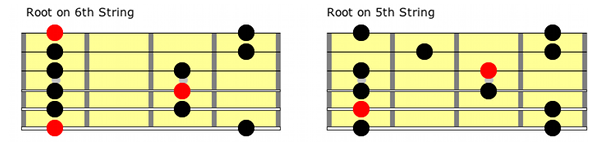
The scale is quick to learn and easy to learn to improvise and phrase with. Once you have mastered the basics of using the scale over a minor chord progression, there is also some more advanced uses based on playing different positions of the scale over a minor chord or moving the scale up or down a fret to get a “playing outside” sort of sound. I might devote lesson to these more advanced uses in the future.
If you would like to practice this scale over a backing track you can use the blues backing tracks or the backing tracks designed for the Aeolian mode or the Dorian mode.
Scale 2: The Blues Scale
Once you learn the minor pentatonic scale, it should be relatively easy to learn the blues scale as it is essentially the same with one additional note (a flattened 5th).
This scale in its two most common positions are as follows:
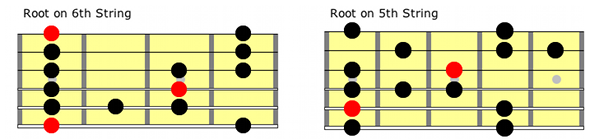
As the name suggests, the scale is used heavily in blues but is also used in rock and jazz based styles a lot too. Soloing over the blues using this scale is relatively easy to get the basics of, but you could spend a life time honing the subtle nuances of the style, such as the feel of the bends, the vibratos and the timing of your phrases.
You can practice this scale over our blues backing tracks.
Scale 3: The Natural Minor Scale or the Aeolian Mode
The natural minor scale is very commonly used in rock and popular styles. As well as being used to form solos, the chords formed from the natural minor scale would be the most commonly used chords in popular chord progressions.
The two main positions for the scale on the guitar are:
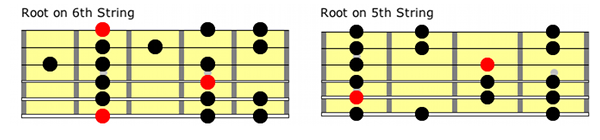
You can read more about this scale in our article on the natural minor scale and you can practice this scale over backing tracks on our backing tracks designed for this scale.
Scale 4: The Major Scale
The major scale is heavily used in a number of ways. The chords formed from the major scale are commonly used to form chord progressions, and there is also a lot of theory on how to form harmonies with this scale.
Additionally, this scale is used to form modes which are also commonly used. The natural minor scale mentioned above as well as the Dorian mode and the Mixolydian mode below are all modes of the major scale. You can read more about forming modes from this scale in our article on the modes of the major scale.
The two main positions for the scale are:
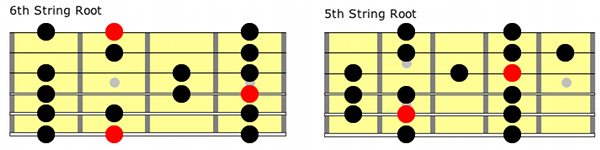
The major scale can be used to form solos over chord progressions that are based on the chords formed from the major scale. The scale is also commonly used to solo over major 7th and major 6th chords in jazz based styles where the scales used may be changing over different chords. You can read more about this scale in our major scale article.
To practice your improvisation with this scale over backing tracks, you can use our major scale backing tracks.
Scale 5: The Dorian Mode
While the natural minor scale is most commonly used in rock and other popular styles to form solos over minor chord progressions, the Dorian mode is more commonly used to play over minor chords in jazz and fusion based styles.
The main positions for the Dorian mode on the guitar are:
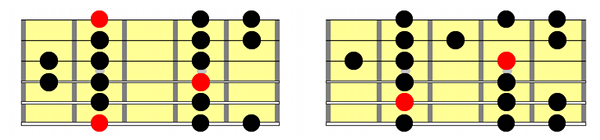
If you would like to practice this scale over a backing track you can use the backing tracks designed for the Dorian mode or alternatively, as the dorian mode is the blusiest sounding mode of the major scale, it will also work over many of our blues backing tracks.
Scale 6: The Mixolydian Mode
The Mixolydian mode is the 5th mode of the major scale and is commonly used to improvise over dominant chords in jazz and fusion based styles.
The two most common positions for the Mixolydian mode are:
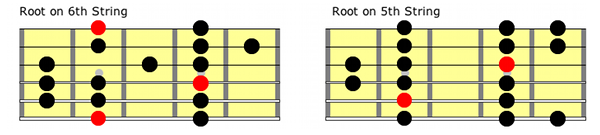
You can practice your Mixolydian soloing and improvisation over our Mixolydian backing tracks.
You might also like to take a look at our guitar scales chart for a chart of the main positions of these 6 scales.
Practicing Scales
When practicing scales on guitar, once you have learned to play a scale position ascending and descending, it’s then useful to start to practice your scales in sequences. This will help ingrain the position of the scale as well as the sound of the scale.
You can read more about practicing in sequences in our article on guitar scale sequences.
You should then start to spend time experimenting with the scale, trying to come up with phrases using the notes of the scale that sound good to you.
Then move into experimenting with the scale over backing tracks. As you do this more, this will become more of a spontaneous process. You can find backing tracks to play all of these scales over in our backing tracks section of the site.
Some Basic Theory to Know for Scales
Probably the most important piece of music theory relating to scales is how to form chords from a scale that can be used together in the same key. You can read more about this in our article on forming chords from scales.
It is also useful to know how to form the modes of a scale and you can read about this in our article on modes of the major scale.
Other information such as the intervals that are used to form the scale can be seen on the articles focusing on each of the specific scales mentioned.
Where to Go for More Lessons
If you are looking to delve more into this sort of material, I would recommend taking a look at the JamPlay guitar course/lessons site.
I am both an affiliate of the course and a member there. They have a good range of video guitar lessons over a wide variety of topics. You can focus on theory, different styles of guitar, beginners courses or different artists styles to name just a few of the sort of categories of lessons in their members area.
They present lessons from quite a few different instructors so you can find an instructor with a teaching style that best suits your learning. Additionally, they provide regular video chat sessions with their instructors so you can personally ask any questions that may be holding you up on the instrument.
The site also has an extensive scale library and I just took a few screenshots of the JamPlay scale library so you can have a bit of a members look at some of their guitar scale resources:
Update: Reading the Neck Diagrams
I’ve seen a bit of confusion about the scale diagrams above, so I thought I would add this section that goes through how to read them in more detail.
In each of the diagrams, the red dot represents the tonic or root note of the scale while the black dots represent the other notes of the scale.
In terms of the key and fret numbers, each of these diagrams can form the scale in any key depending on where you play them along the neck. For example with the first diagram for the minor pentatonic, the red dot is the first note on the 6th string and this is the root note of the minor pentatonic. Now this first note can be played anywhere up the neck, and depending on where you play it will depend on which key the minor pentatonic is in.
For example, if you play that first scale with the red dot on the 5th fret of the 6th string, then the 5th fret of the 6th string is an A and the pattern would represent A minor pentatonic. If on the other hand the red dot was the 8th fret of the 6th string, then this note is a C and the scale would be the C minor pentatonic.
As such, each of these diagrams represents a pattern that can be played anywhere up the neck and the position you play the pattern in will indicate the key of the scale. Each pattern can essentially form the scale in any key depending on where you play it.
I hope you have found this article to be helpful.
Note: For the visually impaired who have technology to allow them to understand the text on a webpage but not the images, click here for a textual description of the scale diagrams on this page.
by 
I play Rhtyum but have no idea how to play lead and dont know what scales are or how to play them . It all sounds confusing and difficult.
And rewarding;) Just takes some time, but it can and will make sense at some point. Sorry I don’t have the skills to do more for you than encouragement. Good luck and don’t forget to have fun with it! *Insert other motivational cliche here*
It will be difficult for a wile but once you have it you will have a better scene for music theory and you will be able to understand it more. The main scales you will need for say rock are penatonic and blues. Just remember the more time you spend the better you will get. if you spend more time with them practicing them at your own speed you will get better and one thing i have come to learn with guitar lead anyway is that girls love a guy who can play a killer solo and the only thing you really need is your scales and some basic theory.
Naw. Girls like the the guy who can play a killer solo in till they meet the drummer. Then it’s all over.
By now its probably too late …cuz i hope u must have mastered scales……But just in case if u havent, or someone who plans to start practicing scales……Don’t give up on scales….Just give it some time…and I Can assure they would start growing on, Start with pentatonic and Major sacles…And don’t just play Try to listen to the Melody, U’ll know it right away when u miss a note…..u
Just think if you would have started learning scales when you posted this you probably would be a master of them
Man, the only reason i’m here is because i need to learn the skills outside of what i hear marty friedman playing. I write my own shit so i really need to understand more than the chord progression to keep it interesting XD
I’ve been frustratedly plonking around on Guitars for 45 years and just decided (having finally bought a new guitar) that I really should begin to understand something about music…….so this is all a complete revelation to me!!! WHY oh WHY didn’t I look at this stuff before???? I think I was just afraid…..it all seemed SO complicated, but you have explained it all brilliantly especially with the guitar tab kind of thing …….I’m going to love learning all this new stuff!!
I’ve been playing 40 years and considered by others as an advanced players. However, I didn’t know the name of the pentatonic scale or none of that until about a year ago. I’ve been doing things I didn’t know what you called them. Anyway, I’m learning the main scales and actually practicing them because I can see the benefit. Even though I have reached a high level in my playing ability, I want to learn more. Thanks to this web site for helping us old heads get with the times. We didn’t have this stuff available when I was coming up. You had to learn a few chords and play along with records. Scales and patterns are things you happened up on. So much easier for kids now.
That’s the best comment on here!!! Way to go man! I’m 37 and have been playing on and off since I was 12. I taught myself for like 20 years and could write my own music oddly enough if I pick up my guitar I will create something eerie and cool. But learning other peoples music I was always against saying you can’t learn that way! But you know what? I was so wrong! Learning other peoples music teaches you a lot about the neck of the guitar and the intimidating fretboard. But now I’m learning skills and turning my leads into something that tells a story not just something that sounds fast. David Gilmore is one of the best players out there and he never compromises the emotion the notes he’s playing bring on for speed. He’s never been a super fast flashy guitar player but he is definitely one of the BEST the world has to offer and he is still learning new things himself! You will never MASTER the guitar BUT, learning some theory and some technical skills is crucial!!!!
I didn’t think I would ever learn how to play scales or even the guitar! I am a disabled veteran with a TBI (traumatic brain injury). I decided to learn how to play the guitar as physical therapy using online lessons and youtube videos.
At first I was so frustrated trying to get my brain to tell my fingers where to go and what to do, simple chords would even stump me. Then I became even more frustrated with trying to remembering the scale positions and notes of the scale. But then one day it just clicked! Literally! The A scale started to make sense, then the E scale, next the Am scale.
Trust me! If I can do it so can you. It’s been a long 5 years.
Please don’t give up!
I practiced an hour a day, everyday. Last year I decided to invest in real guitar lessons in town and now I practice 3-4 hours a day because I am no longer frustrated. I am now actually writing my own solos to backing tracks from YouTube and songs I create with my Band in a Box (BIAB!
My doc at the VA is astactic with my hand and eye coordination improvement.
Yes!!! YOU CAN DO IT!!!
Semper Fi
Awesome! Thanks for your service! Hope its ok to say very inspirational.
What do the red dots mean
Hi Greg,
The red dots are the root note of the scale. For example, with the major scale if you were in the key of A major then the root of the A major scale would be A and the red dot on the major scale pattern would be an A. This would then indicate where along the neck the pattern starts (e.g. the 5th fret of the 6th string is an A)
Hope this helps.
How come there are more than one red dots in the scales?
Also, why are there two versions of each scale?
thanks 🙂
The red dot is the root note, and once you reach another red dot, you have gone through the scale and reached the next root note. The guitar only has 12 notes, repeated over and over again. Each scale uses a different combination of those 12 notes and because of that, you end up playing the same notes eventually.
The first scale is showing the E note as the root note, the second is using the A note as the root. The pattern of which notes will stay the same, but the pattern on the guitar neck has to change because you are using different notes because of the root note.
It means stop.
So, if I really learn all of these, have them down by memory, and have the ability to play them fast and proficiently, will I really be able to improvise
Hi Levi,
Learning these scales proficiently would be a great help to learning to improvise, but there is more required to learn to improvise than simply learning the scales.
One of the big steps will be to learn to form musical phrases out of the notes of a scale. Probably easiest to start with the minor pentatonic. As you learn to play the scale and sequences of the scale, you should also start to slowly experiment with forming phrases and licks from the notes of the scale that you like the sound of. As you do this more, this will become more of a spontaneous process.
This moving from scales to improv is quite an in depth topic and could form a good lesson on the site itself.
Hello fellows…
How are we doing today?
Well, I’ve got to tell you Levi, I’m not sure if I agree with our adm. I think you’ve got to know how the neck works and where you can go. I believe that phrases are created, you don’t have to memorize phrases. You’ve got to understand how scales work in order to sound great, that’s it… after that you’ve got to play with your heart, it won’t ever sound nice if your worried or thinking to much on where you can go… After having a single notion on how scales work then you’re good to improvise…
Cheers…
I hate guitar, my parents force me to go what shoul i do
What are scales
I hate my guitar tutor
Hey Daniel,
Most people who play music do it because they enjoy playing. I tend to think that if your not enjoying it you will have a hard time progressing at the instrument.
One possibility is that if you keep going, you might come to enjoy it in the future, and when you get older you might really like being able to play an instrument. Also, you might find some more enjoyment if you can get your tutor to teach you styles and songs you really like.
I have often met people who started at music and gave up and then came to regret that latter on. If none of this helps and you really don’t want to continue, its probably best to try to get your parents to understand this.
Hope this helps.
stick with it..the Women will follow
Do you hate guitar or hate learning to play it? If you enjoy playing a good song stick with it. Find a better guitar tutor, teacher. If they are not enthusiastic and keeping you interested they might not be the right fit for you. Learning guitar is like washing your car. Sucks cleaning it but it sure looks damn good when you are done. Pick a song that you love that is not to difficult learn it however you need to. Not saying to keep learning like this but learn it and play it. If you do not enjoy like really enjoy playing that song you love then walk away and find something you love. Your parents are making you hate it. Not good. Please show them this comment.
Take up knitting then…shut up and play your guitar.
Please don’t quit talk to your instructor and or your parents about your feelings. I quit when I was a kid and regret it every day. I am 66 years old and just started again. It is easier when your young you will love it once you start to get it.
I am really excited to read up on these scales . I am getting down to working on them immediately. Thank you.
i enjoy these scales, but i wish i understood the diagrams. could there a better explanation?
for instance, i need to know the number of frets these dot are played on, their tonic solfa and probably their keys… i think thats what i need now to help me progress.
already i can play on key c, g and a major>>> i need you to help me here.
Hey Dee chords,
I’ve seen a bit of confusion about these diagrams, so I might work on an additional article soon that goes through how to read them in more detail.
In the mean time, here is some advice:
In each of the diagrams, the red dot represents the tonic or root note while the black dots represent the other notes of the scale.
In terms of the key and fret numbers, each of these diagrams can form the scale in any key depending on where you play them along the neck. For example with the first diagram for the minor pentatonic, the red dot is the first note on the 6th string and this is the root note of the minor pentatonic. Now this first note can be played anywhere up the neck, and depending on where you play it will depend on which key the minor pentatonic is in.
For example, if you play that first scale with the red dot on the 5th fret of the 6th string, then the 5th fret of the 6th string is an A and the pattern would represent A minor pentatonic. If on the other hand the red dot was the 8th fret of the 6th string, then this note is a C and the scale would be the C minor pentatonic.
As such, each of these diagrams represents a pattern that can be played anywhere up the neck and the position you play the pattern in will indicate the key of the scale. Each pattern can essentially form the scale in any key depending on where you play it.
I hope this helps here.
What are the fingerings.
Would love to learn soloing on my guitar,these scales confuse me.Don’t know what scales to use after listening to guitar music or songs.How would I even start?
If your confused about which scales to start with and where you can use them, I would simply start with the minor pentatonic, and learn to form musical phrases with this and figure out what sort of progressions you can use the scale on. Slowly start to build more knowledge as you get this down and you will become more versatile with your soloing and start to understand the context you can use them in more.
Rather than starting by looking at a song and trying to figure out the scale to use, start by learning one scale and figuring out the contexts you might be able to use this scale and expand from there.
I have started looking into lead, saw a good clip on youtube but the guy there said it is best to learn the first five positions in a designated key. Searching for understanding I found your site and looks simpler. I do have a few questions if you don’t mind answering. Why are you starting in the middle of the fret board? How does the pattern on the root on 6th fret relate to the pattern on the root on 5th fret? What am I missing?
Hi David,
First thing, I’ve seen a bit of confusion about these diagrams so have just added a section to the main article that goes through how each of these diagrams can form the scale in any key, depending on the position you play it up the neck. It might be useful to take a look at this section.
In terms of learning scales in five positions rather than two. It is certainly the case that the more fretboard knowledge you have, the better, and you will ultimately want to know each of these scales (and more) in all five positions. However, something I believe is much more important that starting with a lot of positions and scales to learn, is to just learn a few scales and positions and also learn how to phrase musically, improvise and play over backings with a more limited set of positions rather than tackling all the positions at the start and ignoring this more musical side of the playing.
For example, I believe it would be much better to simply know the positions shown for the minor pentatonic and blues scales above, but also be able to improvise great sounding solos with this than it is to memorise say all positions of all the modes of the major scale straight up.
This implies that as well as practicing the scale positions and sequences of the scales, you also need to spend considerable time experimenting with the scale positions to start to form musical phrases with the notes of the scales. You then need to start to do this over backings tracks and keep going to the point that you can do this quite spontaneously (i.e.. improv).
I’m more of a believer in tackling this whole process straight up rather than simply trying to learn all positions before you start on the more musical sides of learning to solo.
The reason for the choice of scales and positions presented above is that I believe that these are by far the most common. For example, I think that these scales and positions probably would account for maybe 80% of the soloing of many accomplished rock and popular music guitarists.
Also, once you have learned what I have presented above, you should have a good understating of the process and it will be quick to add more positions and scales to your repertoire.
Hope this answers your questions.
Old post, but does anyone have a link to the main article he references here?
I play chords but scaleS give me a had time.. Just dream that I could just master scales as much as I do chords.i
How to form melodies solos using minor pentatonic scale?
I have a strange and unique style of guitar playing, granted its not the style I would like to play my brain and fingers do their own thing, I have difficulty covering music I enjoy and my timing is getting better but I just can’t parrot music like it seems most can, I can do chord progressions from standard to power single notation and finger picking which I was given one lesson and taught myself the rest through trial and error, leaving me with multiple albums worth of material for guitar alone… first question is what tips do you have to play in sync with bass and drums? Second, any tips on solos and breakdowns? Third, any advice or tips to aid in learning a cover song? (Cover songs) I find the accurate sheet music I use the same tunings and I understand every guitar has its own unique tone I even attempt to play along with the songs but to no avail it sounds off let alone singing and playing at the same time no love there either. Final question, metronomes I have one I don’t understand it or know how to utilize it in practice not sure how I should set the beats and tempo or when I should be strumming or playing a note?
Hi Hei,
I’m not really sure what advice to give here, but will outline a few points that I think might help based on what you’ve said.
Firstly, although I often have experiences when improvising where my fingers seem to be doing their own thing too, it is certainly important to be able to control you playing when you want and do on the instrument what you intend to do. Probably the advice here would be more practice where you are trying to play what you intend rather than letting your playing go on auto-pilot.
In terms of playing in sync with bass and drums, and why your having trouble with covers could be a couple of things. Some likely candidates:
Your may need to develop your timing. Practice here over drum backings and metronomes will develop this. In terms of the tempo, set the metronome at a comfortable tempo (maybe 100bpm) (in 4 beats per bar) and play something your very comfortable playing along with the metronome. The metronome is setting the beat while your playing should attempt to be right on the beat.
A key point here is while you are doing this, you should be listening to the metronome or your drum beat more than you are listening to your own playing. You may strum different sub-divisions of the beat at different times, but you need to keep the same tempo as the metronome.
To understand this I would suggest searching youtube for videos on practicing with a metronome and also do some searching to read up on the different sub-divisions of the beat that are common.
Some other possible reasons it is sounding out, is you need to make sure your guitar is correctly tuned, as this would make it sound out. Best way here is simply get an electronic tuner (or if you use a smart phone, there will be tuner apps you could explore on your phone).
Finally I would also check you are plying in the right key, but if you’ve learned a song from tab, this should probably be fine.
I don’t think the problem here would be the tone of the guitar based on what your saying.
I’m not really sure what to advise here, but I think these things are probably most relevant.
Ok, I write songs and know what sounds good to the ear for rhythm guitar. But I find myself drawing a blank with lead. Is there a trick to coming up with a good lick consisting of the notes I used. I’m not really too familiar with scales. Or is there a scale consisting of A#, A, and G? Much appreciated
Hi Colten,
Those notes would be part of many larger scales. Some main examples would be G natural minor, G dorian or Bb Major.
To learn to phrase with the notes of a scale takes a lot of time experimenting with the notes to come up with phrases that sound good to you. You can also look at the phrasing of some of the lead players you like to start to get ideas.
Hi! I really wanna thank you for helping me figure out a way of being a good guitarist, my favourite lead for that matter……………….I have over the week improved greatly on my “flows” while playing for my local band…. Thankssss once again….. I will everly remain indepted to your writeup….. Keep up the good work Sire!
Thanks Elaigwu,
I’m glad you’ve found the site helpful.
Thank you for your information on these scales. I’m looking forward to practicing them and eventually becoming a better guitar player.
Superb for once it’s beginning to almost make sense keep up the great work it really is appreciated
Lastguest
I’ve noticed that at lot of the questions have to do with understanding the “red dot” root. GuitarOrb Admin (GO) has repeatedly done a great job explaining what it is. However, I think that there is some confusion caused by a lack of understanding. Perhaps for what it’s worth, I can interject a helpful bit of avice and expand on GO’s explaination. Let me take a “G” chord. The root note – the “G” is located on the low “e” string – the thick one closest to you. That is also called the “bottom” string or the 6th string. On the 6th string, the root is the G located on the third fret. Hence, that is the red dot. If you were to play a scale for a G, that is where one would begin. (Note that a G chord also has a G note played on the first string – the top string, also called the first string. It is the thinnest string. I don’t concern myself with that note. The bass note – the low sounding G is what I’m worried about. It’s my root. Again, in this case, that would be the root. If you play a song in the key of G, that scale would sound “good” – it would fit, and not sound “off”
The same principle applies to the scales with the red dot – the root – on the 5th string, or the “a” string. Consider a C chord. in this case, the root C is located on the firth string, third fret. The scales with the root on the 5th string are the ones you want to use in this case.
One common thread runs through this explanation – that being there is basically no way to learn to play a guitar and grow if you don’t know the notes on the strings and the frets. When I teach, I initially try to get the student to learn the notes on all strings up to and including the fifth fret. Why? Because it speeds learning down the road. As one becomes more versed and proficient in the guitar, it is a very simple issue to learn the notes up to and beyond the 12th fret… all the way to the bottom of the neck to where it joins the body. But, in the beginning, it is essential to learn every note – – sharp, natural, and flat – on each string up to the 5th fret. The difference when one comes to the B and G strings (2nd and 3rd) strings can be confusing, but with a little practice, it becomes a non issue.
My point here is that too many people try to jump too far ahead without learning the basics. And I would be lying if i said it isn’t frustrating at times. But, with a little practice… a half hour – you’ll be absolutely amazed at how for you have come, and how far you can go. Learning to play the guitar has absolutely no bound. There is literally no limit to what you can do or where you can go. But, you need the theory to start off. You need the foundation. Again, YOU NEED THE FOUNDATION, otherwise you’ll sink into a morass of confusion and frustration and end up hating something that could be your best friend.
Not to hijack the site at all – just my observations. GuitarOrb has a magnificent site here.
Thanks for allowing me to post.
Hey Ed,
Great Comment. Thanks heaps for your input to the site.
Much appreciated,
Brett
-I really appreciate Ed’s aptly described explanation of the importance of knowing what you are playing by becoming familiar with the notes you are playing! The concept of learning all notes up to the 5th fret first is a very good idea, and will also help you play with others and even apply the concepts to vocal harmonies.
I played very seriously and was on the road for many years and then almost stopped for over 20 years when I went back to school. Four years ago I started back up when we had a death in the family… What is interesting is that I almost never played scales before the hiatus… I was a fingerstyle player and knew many picking patterns and embellishments, but was rather poor at regular electric guitar solos…
After I started back playing again, all of the sudden I was using scales or portions of them in my writing and playing more lead type of lines rather than just chord fragments that were picked or embellished.
I am so happy to have found this site and scale charts…
I will say this… If you learn and know the scales, the language of music is an infinite well from which you can craft what you want to say with your hands and your heart.
Playing without them (unless you know chords) is kind of like trying to speak without language… sound comes out, but may not mean anything…. And remember that the chords we play come from these scales… 🙂
Hello, This thread has been an excellent read. Thank You All!
My question is about the changes in example scale pattern(s), from 5th to 6th string. I understand finding the tonic or root on the 6th string only, and now finding the root on 5th string is a new concept. So first I see a similarity in both patterns. When rooted on the 5th string It seems the 1st or high E string pattern rolls around to the 6th or big E string, although imperfectly. The question, is there a rule to converting the root 6th to root 5th sting pattern or are we to memorize the new pattern?
Best Regards,
I’ll be 63 soon and I want to get back into playing guitar. I played in a garage band back in the 70’s and loved it and I was ( the lead guitar) player as I was the only guitar player. Back then we really did not have the resources that exist today so my lead playing was limited to what ever I could pick up on my own. I taught myself chords, open and barre and really my approach to leads was pretty much just play single notes based off of the chord that was being played. I didn’t understand hammer-ons & pull-offs ( did not recognize the sounds when slowing down a record) and never knew scales or scale forms.
I’ve tried TABs and while I have a good idea what the symbols mean I find them painfully slow to try and learn a lead section for a song. I want to learn scales and positions and in my mind then I will be able to play leads to whatever chord progression a song may have. So my question is what scales should I concentrate on to play Classic Rock music, which is the style I like. (60’s, 70’s, 80’s)?
Thanks and Keep On Rockin;
Steve Zartman (Funkfan as in Grand Funk Railroad, my fav band)
Hey Steve,
I have two comments here, firstly, for those styles of music I think all 6 of these scales are appropriate and what I’ve presented is their most common positions too. Your first emphasis for these styles would be minor pentatonic, blues scale and then natural minor in that order.
The second thing I would like to suggest is to also keep your old knowledge of playing single note chord tones and learn to integrate this and combine it with your newly learned scale knowledge. It is often the case that the chord tone is a note of the scale and is often a note that is emphasised during many solos. I would try to approach it as furthering your existing soloing with scales rather than replacing it.
I hope this helps.
Thanx guys it realy helped me…please bear with me. Im a beginner
Guys i dont understand the picture(diagrams) anyone to simplify it for me please…
My biggest struggle is knowing which scale to use over any given chord or key. I realize there are no set rules but if I want to solo over a C chord or a song in the key of C major would any ‘C’ scale work or would it be better to go to its relative minor, A? Also, playing over minor chords/minor keys………….
Any input would be appreciated.
Great website, btw!
Hey Adam,
I think related to this it is very important to understand how to form chords from scales, as described in my article on this.
Probably the main approach to start with here is when you see a chord progression, you need to know what the tonic or root of the progression is and figure out which scale has been used to form those chords. You can then use this scale to form a solo.
For example if you see the chord progression C Am F G (repeated) then this is in the key of C major and these chords are formed from the C major scale, so the C major scale would be your first choice, scales like C natural minor will not really work here.
Another example: Am Dm F G (repeated) These chords are formed from A natural minor so you would use the A natural minor scale here.
Dm7 G7 (repeated) through the same reasoning this would be D dorian.
Anywhere you use the natural minor or dorian, you can also use the minor pentatonic or blues and you can also use these on dominant chords in blues to give it a blues feel.
I think understanding this sort of concept is the best place to start in understanding what scale you should use.
Hi GO, Thanks for this site I think its quite valuable. My question is just looking at the pentatonic finger pattern is straight forward for the 6th string, but Im not understanding the 2nd pattern on the 5th string. Are they meant to be tonally different? My example if you use the first pattern and say just the first four notes at C 8th Fret and then use the 2nd pattern on C 3 Fret 5th string the scale is not the same note wise is there a quick explanation for this, or could you please tell me what im missing. Thank you.
GO, I got it I was reading the pattern top to bottom not bottom to top and then when read the way you’ve laid the tab out starting on the 5th string just shortens the pattern by 2 notes.
Hello,
I need to be faster and be able to play notes at up and down the guitar fret, i’m a beginner would practicing these scales help with my speed and technique? or are there other ways, i can play those scales for hours a day if they were to help with speed. Thank you
Hi Pharaoh,
You can certainly use these scales to build speed and technique.
You would probably be best to use them to build your alternate picking speed. Practice the scales ascending and descending as well as the sequences of the scales I mentioned. To build speed you will want to practice them with a metronome. Start at a comfortable speed and then increment the metronome by maybe 4bpm increments as you slowly get faster.
Doing this as a technique exercise will have the added benefit of having learned the scales which you can then go on to learn to form musical phrases and solos with.
Something else to keep in mind is there are different techniques that people build speed with. For example, I’ve recommended using the scales as an alternate picking exercise, but you would need different exercises for say sweep picking or tapping, …
What finger do I have to use in scaling? Do I HAVE TO USE ALL FOUR OF THEM? Iam having difficulty in guitar scaling even i practise, my fingers are to close to each other specially my middle and ring finger. What shuold i do to make my fingers more comfortable or to make make my scaling easier?
Thank you:)
Hi Michael,
Yes, I would recommend using all 4 fingers. I really do think the solution here is more practice.
It might also be worth doing exercises like:
https://www.youtube.com/watch?v=YrfaglMd5RA
Theres all sorts of variations on these sorts of exercises like moving up ad down each string at a time with them.
Hope this helps.
What I want to know is how the music theory applies to making my own music. For example, scales; people say this helps out in dexterity and making solos. But how should I approach in learning scales? Should I just remember where to place fingers? or should I try to remember how each note sound? I mean if I just randomly try to remember where to place the fingers, that’ll just help me in where to place my finger instead of how to go about making melodies/music.
Also, if I want to make rock + pop music, what scales or chords should I study?
Hi Goody,
Firstly, for rock and pop music I would recommend learning all 6 of the scales presented above in the order they are presented.
In terms of chords for rock/pop I would recommend to familiarise yourself with my article on “Forming Chords from Scales”. Once you have a good understanding of that look at the article on the natural minor scale to see the chords formed from this scale. The chords formed from this scale form many of the chord progressions in rock and pop music so once you’ve done this you will have made a good start to understanding the chord progressions of these styles. You should also understand how these chords change if you are in different keys (i.e. be able to transpose the concepts to different keys).
In terms of how to go about learning these scales, initially learn where to place the fingers for a scale and to play it ascending and descending, then practice this with great repetition. Then learn the sequences of the scales presented in my article on “guitar scale sequences” and put a lot of repetitive practice into playing this. Providing you are listening carefully to how this sounds while you are practicing, the sound of the scales will start to ingrain.
You should then spend time, just experimenting with the notes of the scale to come up with phrases that sound good to you. As you go further with this, you will be able to maintain this as a continuous, somewhat spontaneous process. Then apply this over relevant backing tracks.
Hope this helps.
My question: What are exotic scales (the ones that Marty Friedman uses)?
BTW: I really appreciate and salute your work here. YOU ROCK
Hi Rohan,
I’m not really sure what scales Marty Friedman uses.
“Exotic scales” seem to indicate either scales common in non-western derived forms of music (eastern music, middle eastern music, …) but I’ve also seen the term refer to some of the less common scales that are often used in jazz or metal, such as the Phrygian Dominant Scale, The two diminished scales, the whole tone scale or the altered dominant scale.
In terms of tackling these sorts of scales, I really would make sure you have good improv skills over backing tracks of the 6 scales presented above first. You should have also learned the other modes of the major scale and the major pentatonic that are not part of the 6 presented above.
Reason being is these scales will be easier to learn to phrase with and I believe are a necessary first step.
You could then start looking at the more exotic type of:
Harmonic and Melodic minor (ascending) scales.
The Phrygian dominant which has a real flamenco sort of sound and is the fifth mode of the harmonic minor.
The altered dominant scale, used in jazz over alter dominant chords and is the 7th mode of the ascending melodic minor scale.
And then the whole step, diminished and half diminished scales.
Hope this helps.
Maybe I have missed a lesson or two somewhere but I don’t understand the diagrams. I get the red dot is the root note, but why are there 2 or 3 root notes on every scale? How do I know what order the play the notes in and are all dots notes I play for a minor pentatonic scale, which is only supposed to have 5 notes per octave? Wow, this is confusing…
Hi Mark,
That’s right that that pentatonic scales only have 5 notes per octave, but the scales in the diagrams span more than 1 octave, and each red dot is a root note in a different octave. You’ll see that there are 5 notes from one red dot to the next, but you want to use all the octaves you can in your current position on the fretboard.
In terms of the order of the notes. Start by practicing the scale ascending and descending. Start on the bottom root note (red dot) and then ascend up the notes to the highest note. Then descend back down to the bottom, then ascend to the original bottom red dot again. For scales where the red dot is the bottom note simply start at the bottom and then ascend all the way up then back down again.
Once you have mastered this you can then move on to practicing sequences of the scale.
hello,
Please,attach the guitar scales to my mail i want to print it out for practise.
Hi John,
Take a look at the guitar scales chart at:
https://www.guitarorb.com/guitar-scales-chart/
If you right click this image, you should get the option to save the image to your computer.
You could then print it out to practice with.
I really do understand these scales and i sure know how to play them. But i really don’t know what to do with them. I’d love to know how i can play them along with the chords i already know.
Thanks!!
Hi Godswill,
Now that you know how to play the scales, first step you should experiment with them a bit to start to find phrases you like. Then move on to experimenting with them over backing tracks. I might end up putting some backing tracks on this site, but you could search youtube for backing tracks relevant to each scale. e.g. a search for “Minor Pentatonic Backing Track” on youtube will probably bring up quite a few tracks to play over with this scale.
In terms of understanding which chord progressions you can use a scale to solo over, I think related to this it is very important to understand how to form chords from scales, as described in my article on this.
Probably the main approach to start with here is when you see a chord progression, you need to know what the tonic or root of the progression is and figure out which scale has been used to form those chords. You can then use this scale to form a solo.
For example if you see the chord progression C Am F G (repeated) then this is in the key of C major and these chords are formed from the C major scale, so the C major scale would be your first choice, scales like C natural minor will not really work here.
Another example: Am Dm F G (repeated) These chords are formed from A natural minor so you would use the A natural minor scale here.
Dm7 G7 (repeated) through the same reasoning this would be D dorian.
Anywhere you use the natural minor or dorian, you can also use the minor pentatonic or blues and you can also use these on dominant chords in blues to give it a blues feel.
I think understanding this sort of concept is the best place to start in understanding what chord progressions you can use a scale over.
Hi,
I bought my first guitar about a month or so ago, after years of saying ‘I wish I could play guitar’ and doing nothing about it. I know – total fool!!!!
Anyway, Ive looked at many sites and some are better than others (yours being excellent, obviously!). However, I am still uncertain as to what to learn first, so I’m bumbling through learning bits of this and pieces of that. I don’t feel I’ve got any real structured approach to learning. Some people just show basic open chords and say practice them to death – which I’m doing and getting better slowly. Other sites say learn the theory and the notes on the guitar. Although i haven’t yet memorised every single note on every single string/fret, I understand the intervals (starting from C – TTSTTTS) and can easily work out any given note. I’ve even begun to look at chord formations – tonic/3rd/5th make a major chord. ie: for A its A, C & E; therefore open A string is the tonic / 2nd fret on D string is an E / 2nd fret on G string is another A………. etc. Now I’m looking at scales and you seem to be suggesting that its vital to know them first (at least that’s what I think you’re suggesting??)
All this knowledge is great and I understand that eventually it’s all necessary, but I’m losing my way a bit and practicing is getting less constructive day by day and therefore more frustrating. I need some structure for the learning process and would be VERY grateful if you could help. It’s a little demotivating to be able to learn things in theory, but struggle to convert it to actual playing. In reality, I’m probably learning too many things at once, but don’t really know what to prioritise. Should I shelve everything but scales for a while??
Hi Neil,
I’m glad you like the site, thanks.
I don’t really think scales are vital to know first. A lot of this material is more designed for a player who has put in a bit of practice and has some basic coordination at the instrument and wants to start looking more at solos and starting to improvise. Having said that, learning these scales and the theory ideas presented early will still be very valuable.
Starting out, I would recommend to tackle a number of directions at once, both rhythm and single note stuff. In terms of rhythm, learning open chords and developing the ability to change between them quickly enough to strum songs that use them is a good start. You can also learn hard rock progressions with power chords and distortion early too. After all this you can start to move into barre chords and further material.
I would also start single note playing at the same time, learning simple single note riffs and some exercises to develop your coordination. It is here where you would also start practicing these scales and scale sequences I’m presenting.
It sounds like you would benefit from a beginners guitar course to give you the structure your looking for. Jamplay has over 15 of these by different instructors but if your after a free option, I have read on forums that Justin Guitar has a good beginners course on his site, I haven’t had a good look at it but it sounds like the sort of thing that might be helpful.
I haven’t put together one of these sorts of initial beginners course for this site at this stage but maybe in the future. 🙂
Hope this helps and I’m glad you like the site.
Thank you for your efforts. I found your scales very helpful. A few weeks ago, I started with some basic cords and rhythms. These scales you have taken the time to layout seem like a natural next step. Thanks again.
Thanks Joe, I’m glad your finding it useful.
What happens as you move higher up the guitar? The pictures only show 4 frets on the guitar, does the scale just repeat as you move up? Thanks for any help.
I bookmarked your site six months ago when I decided to start learning guitar. Here I am finally taking on the ordeal and you are making it a lot easier for me. My problem is a wayward pinkie. I have been watching what it does when I play and it sticks off in awkward positions or follows my ring finger around like a real basket case. I also find that I naturally fret with the side if my pinkie. How can I change that?
hey everyone
i have just started guitar and have learnt some basic chords, but i think scales give you wider prospects on lead as well as the music itself.
can anyone help with the scale theories and scale formations and how do we derive chords?
all suggestions are welcomed and i’ll be grateful for your help.
warm regards
When soloing is it ok to mix all the scale in solo???
In the diagrams, is the top string the high E or the low E.
Nevermind, figured it out.
What is the difference between root on 5th string and root on 6th string? Which scale should I learn?
hi i hope you know sung ha jung i want to play guitar like the way he plays using that fingerstyle, do you think these scales are big help to start reaching that goal? i hope this site is not yet forgotten thank you so much
A lot of finger style does not use these positions as directly as say electric lead guitar, but often mix up scales and chords together, often in open position. I tend to see finger style as probably more complex, and would require a more extensive knowledge of the fretboard than this, but most good finger style players would have all of the above down pat and moved several steps beyond these positions. I would definitely make sure you have a good mastery of the above as almost a prerequisite for approaching that sort of finger style, and will then have to move beyond that.
Hey everyone,
Thought I’d throw my two cents into this pool of fellow guitarists. I’ve been playing guitar for about 4 years now. I had a fantastic teacher right for the first two, who took it upon himself to implement theory into each of our lessons. I learned the pentatonic, minor, and major within the first few months (or a year at most) of picking up the instrument. I know I’m far from an expert player.. but I do hold my own when it comes to improve solos; I simply love to solo! There really is nothing like it when it comes to this instrument. It is a amazing aspect that I think everyone can only benefit from taking a bit of time to learn. It’s become time for me to move onto more difficult scales, as I begin to bore myself after 4 years of improve; not that there is any true limit to the melodies/solos one can make, but i think some of you may know what I mean. I’m continuing to progress, after 4 years, I still make huge leaps in my skill level. Don’t get discouraged. Keep playing. I highly recommend backing tracks. They take me ‘away’ its such a powerful thing to be able to improvise, I find it therapeutic quite often.
My point here is to encourage everyone out there who doesn’t think the confusion of a bit of theory is worth it to learn the method of soloing.
It is one of the best parts of my life, 4 years ago, and still today. I find myself imagining solos in my head at times of stress, or out of simple boredom. I wouldn’t trade this skill, or education, for the world. I may sound corny, or sappy, but I mean every word of it.
If even one person reaches this place I have so luckily been graced with, this post will be a success. You don’t have to be van halen, clapton, or hendrix…. just be yourself, and I promise the sounds made will feel like an extension of yourself describing all that you are.
The profound nature of my music never ceases to amaze me. This is what drives me, as I hope it does/will for all of you.
Music is a gift, a wonder, and a immense accomplishment.
Don’t let it pass you by.
Best of Luck
Hi Cam,
Thanks heaps for your comments and input to the site.
I started playing about 5 years ago. It has dawned on me that I am not learning to play guitar, I am learning to play songs. I’m 71, and my den is as far as my talents will take me. However, I do play every day, and love it dearly. And just to add another wrinkle, I’m left handed, but am trying to learn to play right handed, cause there are so many more guitars made right handed then left, and also, every tab I’ve ever looked at is for a right hander ! So, here I am, at this great site, and am determined to spend some time every day practicing scales, being retired helps, time is not an issue with me.
I have such immense appreciation and respect for good guitarists, they amaze me , but , I’m doing it for fun, and , I am having fun !
This is the most bad ass and inspiring comment I have read. Keep at it! You rock!
Guys i just want to ask
if you change the chords you are using that means you should change the scale too base on the chord? Thanks guys
It depends on both the chord progression and your approach to soloing over it. Often all the chords in a progression are formed from the same scale and are in the same key and in this case, you often use the one scale over the whole progression.
Take a look at the backing tracks here for the major scale and the natural minor scale on this site. These are good examples of this and would typically imply the one scale. The backing track Funky SRV on the blues backing tracks page is an example of a track that modulates between A minor and B minor and in this case you will change scale when this occurs. You’re often changing the scale you use in jazz too as many jazz standards modulate quite a bit throughout the progression.
There are some song that using chords that is not part of the scale
i mean for example the chord progression is
C G A D so the A chord has c# note which is i think not a part of c major or g major scale
im very sorry sir im just confused haha
it will help me a lot sir if you explain or answer my questionS thank you so much sir
im just a beginner sir6
Hello,
I’m not the kind of person who usually posts to websites. However, I have one particular problem which I can’t seem to overcome. I’ve been playing a very long time. Mostly Rhythm and I even had my own band together where we got paid. So in a sense, some would call me a “Professional”. (Just because we got paid). :-). Anyway, my biggest obstacle to playing “Lead” is getting very nervous about making a mistake or just getting lost. In Musical terms they call these “Accidentals”, but when you’re on stage and you play a wrong note, Everyone knows it :-). How can I over come this fear? I play a 12 String A/E Solo and sing, simply because I don’t have to worry about following someone else’s timing or making myself or someone else look bad. I know all the Major 2 Octave Scales up and down the fretboard. However, when it comes to connecting these together on different strings or jumping up or down a few frets or strings, and still staying in key or hitting the right notes. This baffles me completely. The Blues Pentatonic scales are very easy, but if you just play them every time you do a lead, people (and I) get bored real fast. Any ideas??
BTW: I am self taught and play mostly by ear. I have done a lot of record copying in my time and ruined a lot of Vinyl records in the process. Nowadays, you can slow a song down with a Computer, playing it over and over again to pick it apart :-).
I hope pointing out this method of using a Computer helps the others who have posted on this site. ROCK ON!!! 🙂
Thanks
Hey NeverToOld,
Not really sure what to advise about nerves. Probably the thing that helps me if I’m playing say finger style to people is to start with really simple stuff and then spice it up a bit as you get more comfortable. For example if your finding your blues scale easy maybe start the session with simple stuff on that then when your comfortable with move into more variety or challenging stuff.
I have a few finger style pieces I’ve practiced heaps and come easily to me so I always start with them till I’m more warmed up and have relaxed with the people watching a bit.
Thats great your blues soloing is coming together. In order to spice it up a bit you could try a number of things. Get more variety out of your nuances like bending, slides and vibrato. Maybe try landing phrases on chord tones even if they are not in the blues scale. This can make things really interesting and also explore variety with rhythm. I often see people starting at lead and the’ve got it all together if they just add a bit more variety to the timing of the phrases (how long they hold notes, appropriate use of rests, …).
Hope this helps!
I could probably over come the nerves, IF I knew where I was on the fretboard. I’ve seen Guitarist playing in the first or second position and then immediately jump to the 8th or 10th Fret and begin playing there without missing a note. Playing 2 Octave scales on the 3 or 5th Frets vertically, is very easy. However, linking these together Horizontally or Diagonally up and down the Fretboard is where I get stuck. This is the kind of jumping around which baffles me. Like knowing where the BC or EF half steps are on each string at each Fret. Sliding up the Fretboard on one string and knowing if I move to a lower or higher string, I’m not going to play a D# when I should be playing a straight D note. For me, it’s figuring out where they all are so if your playing in a Major Key, you don’t “Accidentally” throw in a note which doesn’t fit. I have done this before and it don’t sound pretty :-). If I move up the Fretboard 2 or 3 Frets on say the 3rd string, I have to know where to go from there to keep things moving. I already understand the “Wicked B” string. Everything moves up a half step or one Fret. Then things return to normal on the high E String (Thin one) :-).
Your scales outline very nicely the patterns which can be used on different Frets starting at the low E (Thick one), but I’ve never found a site which demonstrates how to move these on different strings. For Example: taking your Blues Scales and actually extending the pattern(s) up and down the Fretboard. Like extending the G Major scale from the first position all the way up to the 12 Fret repeating the scale consistently over all the strings at any Fret. The reverse is also true, starting at the 12th Fret and working backwards toward the nut perhaps playing in a descending order only going from the Low E to the High E strings diagonally.
A Guitarist only has three choices when it comes to playing scales (I’ve been told). Horizontally, Vertically, or Diagonally. Therefore, I would like to find some place where I can learn to link all the scales Diagonally in order to move smoothly anywhere I want to go without second guessing myself or asking myself “If I play this note, will it be the right one and in the right scale?” Does this explain my question a little clearer? It’s playing diagonally where I seem to get lost. :-).
Thanks
Hello,
I think I’ve found what I’m looking for and here is the link:
https://youtu.be/uoSzeLm3U4A?t=21
This is exactly what I want to be able to do. Play in all Keys, 3 Octaves, Diagonally across the Fretboard. I’m providing this to you for information. If you don’t want to post it I understand because it may detract people from your Website. This was and will never be my intension. I’ve been hunting for this information for years (Decades) and I think this will help me get there.
Thanks
Hi NeverToOld..I am also facing the same issue while while playing in front of crowd..I think I also need to practice the same..can you please copy and paste the link again..because the link you had shared is not getting opened..it showing “Web page not found”..
Thanks again,
Debdut
Hello,
I think I’ve found what I’m looking for and here is the link:
https://youtu.be/uoSzeLm3U4A?t=21
This is exactly what I want to be able to do. Play in all Keys, 3 Octaves, Diagonally across the Fretboard. I’m providing this to you for information. If you don’t want to post it I understand because it may detract people from your Website. This was and will never be my intension. I’ve been hunting for this information for years (Decades) and I think this will help me get there.
Thanks
Hey NeverToOld,
Thanks for the link. Great vid. Glad you found what you needed.
wc scales ar best for lingala solo music
Hi Parachan,
I’m not really sure. I haven’t looked much at lingala music before.
thanks 4 the work.i would like to get the lay out of dual scale if possible
Hi … i am finding it very hard to make a melodic solo.. i know the major scale minor and pentatonic but each time i pick up the guitar to solo it just does not give me what i except to get as a lead guitar player i have being for some time now. i will be very glad if you can assist me.. Thanks
Do yourself a favor, head over to learntoplayitright guitar site..$12.99 a month worth every penny, Brad Keller is a great teacher, lots of solos from songs he shows how to play note for note ,he will teach you scales, how to use them, and even throws in some theory you can actually understand.. Can watch the videos as many times as you want and learn at your own pace….I have learnt more in one month than I have in 25 years of playing….
Great man…a ton of thanks..its really helpful to understand the fret board and sure if someone practices these finger pattern through out the neck, he/she can definitely move his/her finger while playing solo.. people can also check the scale sequence page for getting a good speed..thanks again to admin..
Hi
I’m alright when it comes improvising but i have a major problem. i only know the minor pentatonic scale and all of my solos only sound right on a blues or rock n roll chord progression. listening to the kooks and jason mraz or any other form of music that’s not on blues or rock n roll i really love the solos, what scales should i learn i want to make both blues and non blues solos. please help me out.
please email me
I AM LEARNING Guitar since last 4 Years but Nobody tell me about the scales………how it is created or it is already created …..so I want to know about the scales?
Hello, and thank you for the scale diagrams and explanations. I have made up some
printable images (landscape) if anyone wants to put the scales up somewhere (I certainly do), the links are;
Minor Pentatonic and Blues
Natural Minor and Major
Dorian and Mixolydian Modes
Hi Draegor,
Unfortunately the links are not coming up for me. Also, I had to edit the comment for the links to show. Probably something to do with the formatting of the comment.
Google is giving the error: The requested URL was not found on this server when I try to visit the images.
would all of these scales correspond with what would be played on the 4 sting bass guitar? obivouly only the 3rd 4th 5th 6th guitar strings as the 1st 2nd 3rd and 4th bass stings.
Hi Tim,
I haven’t played bass but I’m sure these scales would work on bass with the strings you mentioned.
I need to read up to down or down to up?
Hi Florian
The top string on the diagrams is the high E string and the bottom is the low E string. You can see the bottom strings are thicker on the diagram.
I can’t believe how confusing the diagrams are!! The note at the bottom explaining them make it a BIT better but REALLY, there is NO need for it to be as confusing as you are showing it.
Your images do not show how someone is to progress through from start to finish on any of them.
AND, why oh why is there multiple roots for the scale without explain why that is?? It is confusing as hell to have multiple red dots without understanding why.
GRRRRRRR color me frustrated with this site.
Dude! This just opened all new soloing doors for me! Very good article! I’ve been noodling for hours now!
Personally, I thought it was obvious what the red dots were. The root notes in the scale.
Pro tip for people learning these scales: Do them in triplets (1-2-3, 2-3-4, 3-4-5-, etc. play three notes, then go back one note as the first of the next three notes). It’s a great exercise!
Thank you for this. But I have one question how are scales related to chords. I saw one man play chords on keys which are part of the minor pentatonic.
AT LAST …..Thanks for your totally illuminating explanation of the relation between frets, strings, keys, forms/shapes and modes for working scales up the neck. For months I’ve been utterly frustrated reading articles full of neck shapes and diagrams linking to each other but never explaining the fundamental basis of their relationships (a bit like getting windows 8 to work normally). Thanks for being the first (among those dozens I have read) to realize that maybe some of your readers may not already understand these fundamentals.. From an eighty year old.
Thanks for your feedback Figgy!
Hi, after practicing the blues and minor pentatonic scales how can I form a chord in these scàles? Pls help me
Hi Emmanuel,
People typically don’t use these scales to form chords but rather use the diatonic 7 note scales like the major scale, natural minor scale or harmonic minor scale to form chords. You can read how to do this on the “Forming Chords From Scales” article.
Wow, this really helped me out, ive been going for years not sure quite how scales work and reading this suddenly made it click for me, ive been playing the scales over some of the backing tracks and its so fun!
This is a great website and will be a resource for me as I master these scales. One question, I am wondering where I can learn some lead phrasing examples of these, such as the mixolydian scale, even in popular music. And some examples of blending two different scales such as natural minor and blues….. Much to learn!
I don’t know what’s the use of these scales and how to and where to use it..
I want to know what order I should learn scales to play guitar.
I want that order based on which scale has the most structure to which has the lowest amount of structure.
I also hear it’s better to be taught intervals as opposed to shapes.
I have recently switched guitar instructors just to see how this one teaches.
I have a disagreement over which scales should be taught first.
This goes back to how you learn anything in life.
By the way new instructor does not necessarily seem different than the previous instructor which gives me doubt on guitar instructors today.
But getting back to my point anything you learn in life you are usually taught structure before you can do improvisation.
You must teach a child how to ride a bike the normal way before that child can do tricks on the bike when they get older like a ghost rider or whatever you want to call it.
Which is why I don’t understand how you can teach someone minor pentatonic scale first if the same instructor is telling me it is a solo scale and mostly improvisation and the major scale has more structure.
It feels like I am being taught backwards.
I read in a guitar blog the major scale teaches you how songs are built and how to harmonize and chord tones which the blog said any good solo has.
I did that briefly with that instructor but no that long ( maybe two weeks).
I also was not taught complete songs.
These instructors should have brought in songs sheets from popular guitar music.
My new instructor is teaching me how to play more than one scale off a blues chord progression particularly major pentatonic.
My basic point is that the guitar instructors I have while they know rock music they seem to want to be more influenced by the blues.
I also like the blues but don’t feel I am being taught music in the correct order where I can get the most out of myself and sound decent.
I practice hard up to this point but feel discouraged I don’t feel I can play anything recognizable.
When I talk to my instructor he has a loose interpretation of what is popular music.
I would rather learn from a one on one instructor than from a program on the Internet.
I don’t want to travel far either.
I live in a big city and after going with an instructor for a year and a half tried a second and third instructor.
I try learning songs on YouTube and alway one thing that get me confused.
I did not think about changing instructors till it was brought to me that I don’t play anything popular and it’s true.
I feel like the blues can be really awesome to play if I was taught music in the right order.
That does not mean it is the backbone of teaching guitar music.
I feel like these instructors are that are influenced by the blues want to pay homage to the blues but act like it is the backbone of teaching guitar music which I don’t agree with.
You should learn the blues eventually but like I said in the right order.
They seem to have guilt over the fact that alot of music was stolen from blacks which is true.
But that does not mean it is suppose to be taught first.
It goes back to how most people learn anything in life structure then improvisation.
I practiced with my previous instructor for three or four hours sometimes four hours but I don’t feel I play anything recognizable or melodic.
My new instructor saw that I had learned all the shapes to a minor pentatonic scale and gave me the major pentatonic shapes to the that blues scale which I am now mixing into my solos. I had just had my first lesson with my new instructor.
But I feel I will never learn to be a decent guitar player because I feel I am being taught backwards.
Do you have any advice?
To reiterate I feel like I am not getting the most out of my abilities with my previous instructor.
The new one who I have had one lesson with so far seems to be more influenced by the blues too.
Neither seems to be as influenced by rock.
I understand that Rolling Stones and ACDC used minor pentatonic scale but that does not mean it should be taught first.
Like I said structure before improvisation.
I want to get the most out of my ability and be melodic.
Hi Dan,
I won’t address everything you’ve commented on but will mention a few of my points of view.
I do believe that blues is the foundation of a lot of learning popular guitar and the foundation of rock. When I used to teach I always had my students learn blues as well as what they were interested in. I believe it is a good way to make your soloing sound musical in a short amount of time. So on that point I tend to agree with your previous instructors.
In terms of scales, I suggest people learn them in the order presented above. By starting with the pentatonic and blues scale, it is a lot harder for a phrase in your soloing not to sound good than it is with scales like the major scale. You are right that there is a lot of theory around the major scale in terms of the structure of chords and chord progressions and I think this is also good to study that too. I don’t think it should be too long after starting working on scales that you’ve looked at the basics of all 6 scales above so that would include blues and major. I would then develop my phrasing with the scales and my understanding of the theory at the same time.
Hope this helps.
I don’t think that that this pattern based approach is very good, because it doesn’t actually help you to understand the sound of each scale. This is the best method that I know of for learning scales http://www.edwardjonesguitar.co.uk/blog/-learn-all-of-your-basic-diatonic-modes-and-scales-in-8-steps
You should put the ‘how to read necks’ section first, maybe as something expandable. Or have some link at the top.
I appreciate the diagrams. I play most of these but never knew the names of the progressions. I have always seen patterns not chord structures. When you lock into the patterns you can play any of these on any note. I think for beginners, learn where the notes are on the neck by walking them up and down on each fret and realize they are exactly the same as each note on a piano keyboard. Then even a basic chord structure can be moved up and down the neck to create a different chord. Example: A “D” chord can move up to fifth fret to create an “F” chord structure. (D,D#,E,F) Then up to seventh fret to create a “G” chord. It works with all basic chords but not all will ring true. Find those chords for yourself by moving any basic chord up 1fret at a time until you find the ones that sound right. Lead patterns can be moved up or down anywhere ,you just have to know the root note. But beware Country Western leads, they are structured four frets down beginning and ending on the root note. Example: If the song is in “A”, the lead will be in F# diatonic but beginning and ending the lead notes on “A”. Good luck and keep playing, I never took a lesson but read everything on music composition I can find.
Please give me some advices on how can I learn octatonic scales easily ?
Great site, learning lots, Thanx…
I can’t relate how a melody is formed from the scales
I’ve been playing scales for years and didn’t know they were these shown, my ex-roommate showed me how to play years and I forgot the names. I wasn’t aware there was more to them than what I learned now maybe this will peak my interest in playing again, Thx
The root string on the 5th string is a d and not an a like the one pictured to the left? Why are a and d associated with each other? or is it meant to be moved down the neck of the scale on the octave if we are looking for the a on the 5th string. Thanks
Yes, it’s moved down the neck. These are two positions for the scale in any key so in the key of D the 5th string root would be at the 5th fret and the 6th string root would be at the 10th fret.
What I don’t understand is that bar across the first fret. Am I suppose to hold it down or capo it?
This is a confusing fingering chart. Think about how many comments you have asking you questions. I got the red dot thing….. but the strange dots on the first fret?
This sounds like really helpful information, but needs to presented in a way where you don’t have over 100 comments asking questions about dots and frets.
It’s not very well explained to complete beginners unfortunately. There is no “first fret”, and the dots are positions of single notes you should be playing (not barred), starting with the red dot on the bottom string (6th string, bass string). Based on which scale you want to use, you overlay this pattern on the starting note anywhere on the fretboard.
Looking at the first two diagrams: So for the A scale, the red dot becomes the 5th fret on the 6th string, because that note is A, your root note. For the D scale, you start on D, which is the 5th fret on the 5th string (which is the 2nd diagram).
The reason there are two diagrams is because these are the most common: you can find the start of any scale on the bottom two strings.
Good luck
I’ve been looking up articles on how to play scales and their various positions on the fretboard. Thanks for making it all so clear. The confusion is gone.
This is a great resource, but wanted to point out for those who might be just beginning – what’s posted for the sample notes on the scale is not repeated exactly as you go on up the fretboard. This is obvious for someone who knows about the scales, notes, etc…. but it might not be for a beginner landing here. From experience, I can tell you it’s much easier to SEE where ALL the notes are all over the fretboard and practice that pattern rather than trying to figure out where the next set goes by ear. Once you practice going all the way up and all the way down the ENTIRE pattern becomes muscle memory.
To make it a little more confusing, (to use the minor pentatonic for an example) what’s shown here are only two chunks and they’re not the connected chunks. for the pentatonic the graphics on this page show the first part (the root pattern) and then skip to the fourth “part.”
I was lucky and learned this as a teenager from an instructor that taught me to draw out the entire scale on a fret map and learn how they’re all connected (all the “parts”…not sure about the exact terminology here).
This is probably what Draegor X posted…but his links are now dead, unfortunately. It must have been something like this: https://www.theguitarlesson.com/wp-content/uploads/2012/09/minor-pentatonic-shapes.jpg
For anyone starting out with scales memorize those patterns in tandem and then it’ll all gel a little easier for you. Then you can start skipping around all over the fretboard and improvising instead of always looking for the root on the sixth string.
the article is really helpful and has added more knowledge about this awesome instrument # guitar
Hope for all!!
To give you the bigger picture, I received my first (terrible) guitar at 13. I’m now 41. I have written over two hundred songs, some published, some admired, some thrown away. I managed all along by being able to write a song using the chords I know and have learnt along the way.
The one biggest embarrassment in life was when in a rehearsal room, the boys would, “jam” and I’d be there, sitting pointlessly not being able to play along.
After 25 years of playing acoustic only, I recently bought a Fender jaguar. With the action just how I like it. I finally bit the billut and decided it was time to learn the fundamentals and scales of guitar. After a quarter of a century, it seemed like the right time.
I have used Guitar Orb for a total of 6 hours and have fully mastered the first two, “minor chords” and quickly moved on to the, “blues scales”. Again, mastered within a few hours.
This may seem strange, but after playing guitar in bands for over 25 years, I now feel like I can actually play with my fellow band members. Whenever a, “jam” session was kicked off, I’d sit with my hands under my arse! Were rehearsing on Thursday and I’m fully confident, I will be playing the blues in D, A or any other key they through at me.
This is purely down to the simplicity of the layout from Guitarorb.com
Simple diagrams, good explanation, amazing website.
I’m on fire again when it comes to playing. This website has opened my eyes, unlocked my ability and made me fall in love with the guitar again.
Before I used to simply use the guitar. Now I look forward to and genuinely enjoy playing my guitar.
Great site. Nice and basic. It’s changed my life.
Russell Smith – Cigar Cigar.
Thanks for the feedback Russell!
– I can play chords with no issues. Trying to understand the scales as I was told to learn that as a basic necessity to start getting much deeper into playing guitar.
– Based on formula WWHWWWH, I can understand how every major scale is made
Now the trouble:
– What do I do next?
– How do I apply into playing?
– Should I play scales up and down the guitar fretboard by following the scale formula?
Very confusing to me. Or should I just memorize the fret positions and play or I have to play based on the scale positions in mind?
– When I listen to a song, how do I know what scale is used?
– How can I play a solo faster with the help of the scales?
Really like to learn, but I need to know the next step. Any help in guiding me in the right direction would be helpful.
Well as a young guitarist I would say that the only way that I got good at scales was by just practicing or asking someone who knows the scale like the back of their hand. These scales are useful when trying to understand different guitarist and the way they play or the way you play. I mean I have been playing for five years and yet I still practice new ones because it just also make you as a guitarist unique because you learn to utilize your skills the way you can only do it no one else.
I know them very well and i know where they came from.
I know every root and i know to play combined all of them in every frets.
Some encouragement for aspiring guitarists…..I am 67 and taught myself to play rhythm guitar after taking piano lessons from age 6. I applied the basic theory of triads and worked out the notes that my fingers could get to. I do pplay some chords with different finger positions!! Anyhow, I digress…….having played in many bands since school days and always been lead vocalist/rythm , I decided a few months ago to invest in a new guitar and the new Spark40 amp. I had to start learning all over again and I am now working on a practoce schedule of 1 hour of scales a day plus some relaxing playing and singing. I have learned so much about the guitar that I never knew and the theory helps so much. It is the srthritic fingers that are a problem. But to all of you struggling with whatever…….keep at it! You CAN do it. PS Anyone here have any backing tracks to 60s music?
[…] Next, you’ll need to learn to play the major scale since this is necessary to learn how to play essential chords and scales. […]
Hello There
For almost 3 years I have been reading about scales theory (a lot) and and practising scales (not a lot) because i couldn’t understand the transition or the connection between the scale theory/diagram and the practical side of it which is soloing. I have read this page few times a long time ago but I have to admit i could not make the connection. two years past and today I was revisiting the subject and the first thing I opened is the link to this page and I want over it couple of times then i saw your explanation on how the scale diagram can be applied to a key and how the root note determines the key and the starting position and the penny dropped. Scale diagram + root note + starting position determines where to play the scale and what sound you want the scale to be and then it’s up to us to be creative in terms of how to play the notes in the scale.
Moreover, it made the connection to and made sense as to why it’s important to memorise the notes on the fret board, because we need to know where are the root notes of the scale so we know where to play it on the neck and stay within the key.
Therefore i think it’s important for anyone who wants to the learn playing solos is to understand this principle/connection first before starting to practice, because like me you will be practising and you will be very good in playing the scale but have no idea how to transfer that skill into actual soloing lick or riff.
So thank you for the additional simple explanation because it finally made me see how the scale works from a practical sense within any key and why and how memorising the notes on the fret is important to this aspect of playing the wonderful instrument we call the Guitar.
All the best and peace from Australia
Adam
trash: your lessons hard to follow when you got figure out everything your self
What does the root mean?