
Natural Minor Scale


 by
by 
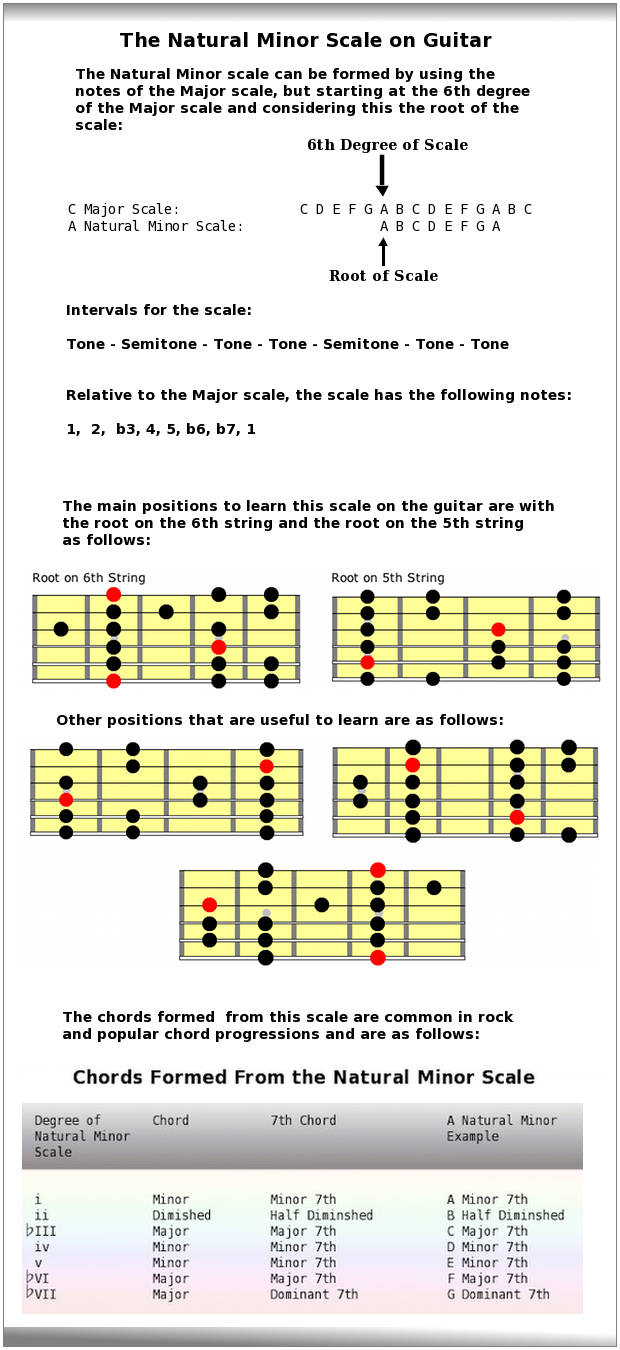
The natural minor scale, also known as the Aeolian mode is one of the most used guitar scales in rock and popular music.
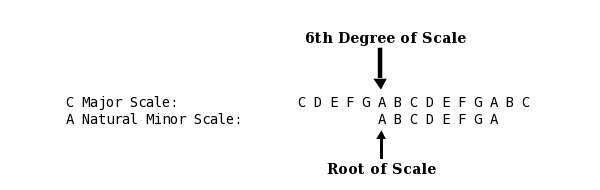
The scale can be formed by using the same notes as a major scale, but starting and ending the scale on the 6th degree of the major scale, and considering this 6th degree as the root.
For example, you can see the relationship between C major and A natural minor in the diagram:
If you look at the notes of the natural minor in relation to the notes of a major scale with the same root, we have the notes:
1, 2, b3, 4, 5, b6, b7, 1
That is, if you flatten the 3rd, 6th and 7th degree of a major scale, you have the natural minor scale with the same root.
The combination of tones and semitones that form the scale are as follows:
Natural Minor Scale = Tone – Semitone – Tone – Tone – Semitone – Tone – Tone
Guitar Positions for the Natural Minor Scale
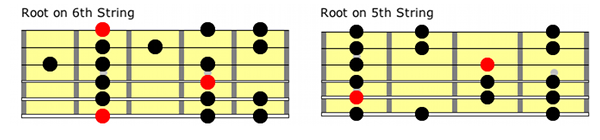
Similarly to the major scale, there are five main closed positions to learn for the scale. I always recommend starting with the two positions with the root note under the first finger on the 6th or 5th string.
These positions for the natural minor scale (with the root note circled) are as follows:
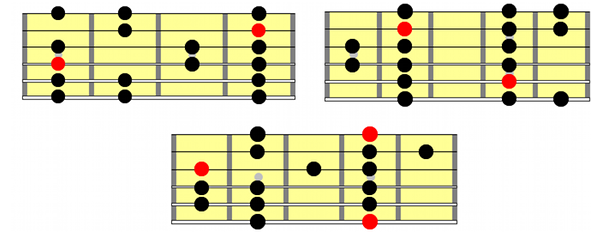
You can then progress to the remaining three positions as follows:
When practicing these positions, in addition to practicing the scales ascending and descending, I also like to practice sequences of the scales as well. You can read about practicing scales in sequences in our article on guitar scale sequences.
The Chords Formed from the Natural Minor Scale
You can use a scale such as the natural minor to form a family of chords that often work well together in the same key. To read how this is done, take a look at our article on forming chords from scales. That article takes you through using the major scale as an example, but you can apply the exact same procedure to form chords from the natural minor scale.
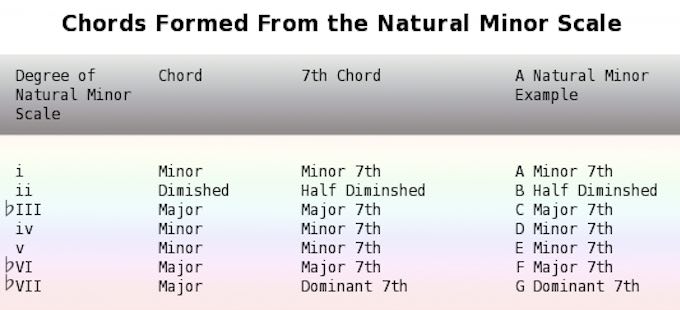
You can see the chords formed from this scale when looking at the numbering (or degrees) of the notes of the scale, as well the example in the case of A natural minor in the diagram as follows:
Use of the Natural Minor Scale
The natural minor scale is probably the most used scale in styles such as rock, pop and many other forms of popular music.
Many of the progressions in these styles will be based on the chords of the scale shown above and many popular songs will feature guitar solos over these chord progressions that are entirely built from this scale.
You can practice your soling and improvisation with this scale over our backing tracks designed for the aeolian mode.
by 
It is very informative and useful for an aspiring guitarist like me from India. Apart from the 6th and 5th String Positions starting with the 1st Finger on the Root, please explain me as to start with Which Finger in the rest of the 3 Positions. It would be much helpful. Thankyou.
Hi Dominic,
For the position where you have root under the first finger on the 4th string, the pattern would also start on the first finger as well.
For the next pattern that also has the root on the 5th string, I would start the pattern with my 1st finger and then move my hand down a fret at the 4th and 3rd strings then back up for the 2nd and 1st strings.
For the final pattern, I would start this pattern with my second finger and then move my hand position up a fret for the 2nd and 1st strings.
Where exactly on these scales you move your hand position can vary depending on the phrase your playing, but these suggestions should be good for learning the scale ascending and descending.
Also, these suggestions are if you are starting at the bottom note in the pattern, but you will often want to practice the scales starting at the root as well.
Hope this helps.
I’m trying to learn scales now , (practiclly i can play slash ,Metallica…etc but dont know much
Guitar theory)but I don’t know which scales to learn , I mean when you learn chords its the basic A,B,C,D,E,F,G chords and I thought same is the case with scales , but when I searched C major scale , I found completely different scales all claming to be c major 😀 ,and same is for the other G,D etc , help!!!!
Hi Pranil,
I’d say the reason your seeing multiple different versions of each scale is that scales adopt different patterns depending on where they are played up the neck. In the CAGED system, which is probably the most common method of presenting guitar scales, each scale can be played in one of 5 positions.
What I recommend is to take a look at the Guitar Scales section of my site and there you will see the six most common scales, each presented in their two most common positions.
Also, pay special attention to the section at the bottom: “Update: Reading the neck diagrams” and I believe this should communicate this concept pretty well.
I hope this helps.
I am a beginner in guitar and music theory. You seem to have a fantastic understanding of the guitar and music theory. So, would you help my understanding as to relationships of music scales to octaves. You probably addressed this above, but it is above my present understanding. Here are a couple questions that I need clarifications about. You help will be much appreciated.
I think I understand the basics of forming the scale of a Major Key, Converting the Major into the Relevant Minor, and forming the scales of that Minor. Again, I think you addressed this above, but I want to make sure I understand.
#1. Is the Relevant Minor of a Major always the same as the “Natural” Minor?
#2. It is stated by many that the Major and the Minor Scales are the same. However, it would seem that they do not ALL share the same octave. For example, A Minor example you used above is the natural (relevant) minor for the Major C (as you stated) it appears that the C, D, E, F & G are an octave above the same notes uses in the Major C Scale!!?? Thus, if I were to make a normal C note in A Minor, it would be one octave above the first C Note in the C Major Scale. Correct or am I missing something here???
Thanks,
GB
Hi Gerald,
I’ll try and clear up any confusion here.
Firstly, rather than “Relevant” minor it’s “Relative” minor. So A minor is the relative minor of C major.
The relative minor is not always the same as the natural minor. The relative minor is a minor key and the scales of this key could be the natural minor scale, the harmonic minor scale or the melodic minor scale.
Other minor scales such as the dorian mode or the Phrygian mode are not really the relative minor of the major scale as they are not formed from the 6th degree of the major scale.
In terms of the octave, it is best to look at scales and this sort of theory as independent of the octave the notes are played in.
So for example, the A in A natural minor could start on any of the A’s above or below the C of the C major your looking at. Depending on where you start some of the notes may be octave(s) higher or lower than in your c major scale, but for this purpose they are still really considered the same notes of the scale. Additionally, keep in mind that scales are often played over several octaves, which would result in more common tones.
Related to this, consider that E is the 3rd of C major. This is considered the case when you are in the key of c major, whichever octave you play the E in.
I hope this helps clear this up.
I still don’t understand how you use the same “formula” and get two different results. If I use the Major C Scale to compute the Relative Minor of A, and then use the Major Scale and starting with A and using the WHWWHWWH, I get A, B, C, D, E, F, G, A as the Relative Minor Scale which you show in one place as the Natural A Minor Scale. This does not acagree with the Natural, Melodic nor the Harmonic Minor Scales. So, the Relative Minor Scale must only be in theory and you don’t use it as A Minor when playing a guitar??? What am I missing here, please?
Now when I was speaking of octaves I was referring to the Major verses the Minor Scales in their relation to the middle C on sheet music. It would seem that the A, B, C, etc would be the A in FACE and B in boy and C in FACE, etc?? Where am I going wrong here as I understand you can have more than one octave in a Major or Minor Scale??? It’s the starting point on sheet music I’m trying to locate?
Thanks in advance for your patience!!
GB
Hey Gerald,
The formula your looking at is not a set way to construct the relative minor of a major scale. It is a way to construct the natural minor or Aeolian mode. Starting a scale on the different notes of the major scale is the formula to construct modes of the major scale, but is not the only way to construct the minor scales that can comprise the relative minor key.
In the harmonic or melodic minor scale there are one or two notes altered from the natural minor, and therefore they don’t share the same notes as the major scale and as such the above formula is not relevant to them, even though they are still relative minors.
For the purpose of rock and pop, the vast majority of songs use the natural minor above out of theses three minor scales to construct their chords, chord progressions and solos/melodies, …
In say classical however, the harmonic minor scale is the main minor scale used in constructing harmony, resulting in a different set of chords in the key and therefore different common minor chord progressions. Additionally, as metal has a definite “neo-classical” influence, you can often see say the harmonic minor scale there.
I think your incorrectly extending the above formula and assuming this applies to all relative minor scales, but it is only for the “modal” natural minor scale.
In terms of the starting point of the scale, you are right that according to the formula, if the starting C in C major was the C on the staff in FACE, then the starting A of the natural minor would be the A on the staff in FACE. However, in practical application, the scales are actually independent of the octave.
For example, C major is the notes C, D, E, F, G, A, B, C and then according to our formula, the natural minor scale is the notes A, B, C, D, E, F, G, A.
However where on the staff you start these scales can be any of the C’s for C major or any of the A’s for A minor.
So the formula has only constructed our sequence of letters, but say the starting A of the natural minor could be the A on the staff in FACE, or the A above the staff or the A below the staff (or even several octaves above or below this). All of these scales starting on different A’s are still the A natural minor scale and as such a scale is independent of the octave it is played in.
Is this making more sense?
From what I see and I’m very novice minor scales are made with 2nds , 4ths and 6ths as they occur in the scale and so you can interchange them for instance a g# is also an Ab or A flat and may be used to make a minor instead of a proper natural minor. Again I may be totally wrong but that’s what I’m getting from it
SUPER IMPORTANT QUESTION! Its confusing me so muchhh. Or perhaps it is the lack of sleep. ANYWAY:
If I’ve learnt how to play the 7 mode shapes corresponding to the major scale and linked them together across the fretboard, then I can play, say the Aeolian pattern and extend it up and down the fret board yes? Since I know the other 6 patterns anyway.
Hence my question is, given the above information, what is the point of learning ANOTHER 5 separate shapes for the Aeolian/Minor? OR are they basically derivatives of the mode shapes themselves?
Hi Rajat,
Thats right, the 5 patterns for each of the modes of the major scale will be the same notes, so once you’ve learned one it will be quicker to use them for another mode.
When playing with them, because the different modes have a different note as the tonic or root note, even though they are the same pattern you do view them a bit differently and will need to practice them in the context of that mode a bit, but it will come together a lot quicker than the first time you learn them.
Hello.
I wanted to ask about minor scale…
I see that in natural minor scale, 5th degree is must to be minor 7th.
now, when i played Autumn Leaves in Gm, they play 5th degree D7 and not Dm7. can i ask why? and how i can know when i should play Dominant or minor 5th degree in Minor scale.
Thank you.
Hi Noam,
Great observation about the 5th of Autumn Leaves.
When harmonising in a minor key, it is often the case that the all the degrees of the scale are harmonised with the natural minor except the 5th degree which can be harmonised with the harmonic minor scale, resulting in the dominant 7th you can see in autumn leaves.
Different chord progressions may use the natural minor or the harmonic minor to harmonise the 5th depending on what sound they want. The backing track “Stay Away from the Voodoo” on our “Aeolian Mode Backing Tracks” page is an example of harmonising with the Bm7 from the natural minor, while, as you mention Autumn Leaves uses the Dominant 7th from the harmonic minor, as well as songs such as “I Will Survive” and indeed most dominant chords in jazz ii V7 i progressions in minor keys.
The use of the dominant 7th gives the chord a greater feeling of wanting to resolve to the i chord.
Probably the next extension of such a concept is that the 7th degree in a minor key can sometimes be formed from the harmonic minor, which would result in a diminished 7th chord such as a F#dim7 in the key of G minor. When the 7th is harmonised in this way, it is acting as a dominant and can be a substitution for the V7. For example try playing the Autumn Leaves progression with the D7 replaced with F#dim7 to see the effect. Then try having the first two beats of that bar as D7 followed by F#dim7 for the next two beats (e.g. | D7 F#dim7 | ).
I’ve been thinking about adding a section to the site on understanding chord progressions for a while. After covering harmonising the chords of the major and natural minor scale, this use of the dominant 7th in a minor key would be the next topic covered.
Great observation.
I want a guitar on major and minor keys of A,B,C,D,E,F&G.
First Thank you for your post.
Sir, I will be proud of you if you send the “Name of some books with author and publication name for lerning Spanish Guitar”, in my email adaksanjoy06786@gmail.com……………….please……please…….please… help me.
Thanks, for the information about the chords and scales.Would you please tell me how to find the correct chords in any type of song.Please help me with this,I would really be grateful to you
Hi! Thanks for your dedication for this wonderful website. I really enjoy it a lot and I think I do have some improvement in my playing.
Just one thing I don’t understand. What’s the difference between CAGED system and the system that you teach here?
Hi Daniel,
Glad your enjoying the site.
The CAGED system breaks the neck into 5 different positions. Each chord, scale and arpeggio can then be learnt in each of these 5 positions.
The 5 positions presented for the natural minor scale above are the 5 CAGED positions.
When I present 2 positions for the other scales, I am presenting what I believe would be the 2 most commonly used of the 5 CAGED positions.
By teaching 6 scales in 2 positions, it is my hope that students will be able to get a basic mastery of this material so they would be able to solo in say 80% of a blues, rock and pop context with minimal material being needed for this. Also by limiting the amount of patterns learned I hope the student will start to develop their phrasing and start applying all sorts of nuance to their playing very early in the piece.
I am a big fan of viewing the neck in terms of the CAGED system and believe that as you start to get a good mastery of what I have presented you should go on to continue to learn all 5 positions for these scales and also other scales, chords and arpeggios in all 5 CAGED positions.
Very interesting and informative nice one.
Thanks for a fantastic site!